| Straight Gravity Wall Installation
| ||
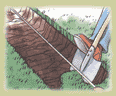 |
1. Begin your project by staking out the border of the wall you are going to build. Using a shovel or a skid loader, dig a trench along this line. If you are going to use one, two or three courses of block, make the trench about 2" (50.8mm) deep and about 12" (.3m) wide. If you are going to use four courses of block, make the trench about 4" (.1m) deep and about 18" (.5m) wide. Firmly compact the soil in the bottom of the trench.
| |
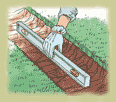 |
2. Lay 6" (.2m) of compactible base (sand and gravel) in the bottom of the trench and compact. This is called the leveling pad.
| |
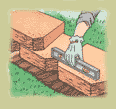 |
3. Place a block at the corner, lip removed. Once the corner is established, lay the rest of the base course working from the corner out. (Lips must be manually knocked off units before placement on the leveling pad.) Position the Anchor blocks side by side, in full contact with the base, and level in both directions using your carpenter's level.
| |
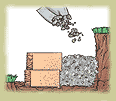 |
4. If the wall is one, two or three courses high, half of the first course must be buried.
| |
| 5. Backfill after each course is laid. First, shovel free draining aggregate directly behind the new course of blocks, extending out about 12" (.3m). We recommend using 3/4" (.75mm) minus crushed rock with no fine. We do not recommend using pea gravel. Then shovel soil behind that. Organic soil or clay type soil is recommended for back fill material. As a general rule, the backfill soil zone should extend as far behind the wall as the wall is high. For example, one foot back for a one foot high wall. Next, compact this soil backfill zone.
| ||
 |
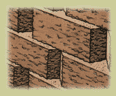
6. On the second course place all blocks along one wall, on one side of the corner. Stagger units in relation to the course beneath, (running bond) pulling each unit forward until secure. Once a new course is laid, backfill with aggregate and soil and compact.
| |
 |
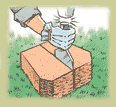
7. It may be necessary to use partial units to maintain running bond. To split a block, use a hammer and chisel to score the block on all sides. Pound the chisel on the score line until the block splits. If the block does not split easily, you may need to use a circular cut-off saw with a masonry blade. Read and understand the operating manual before using a saw. Always wear eye protection when splitting blocks. Alternate the position of partial units every other course and always adhere with a concrete adhesive.
| |
|
8. Repeat these steps until your wall is complete.
|